Gear sits on a shelf or floor
It is exposed to heat, movement, spills, and accidental disconnection.
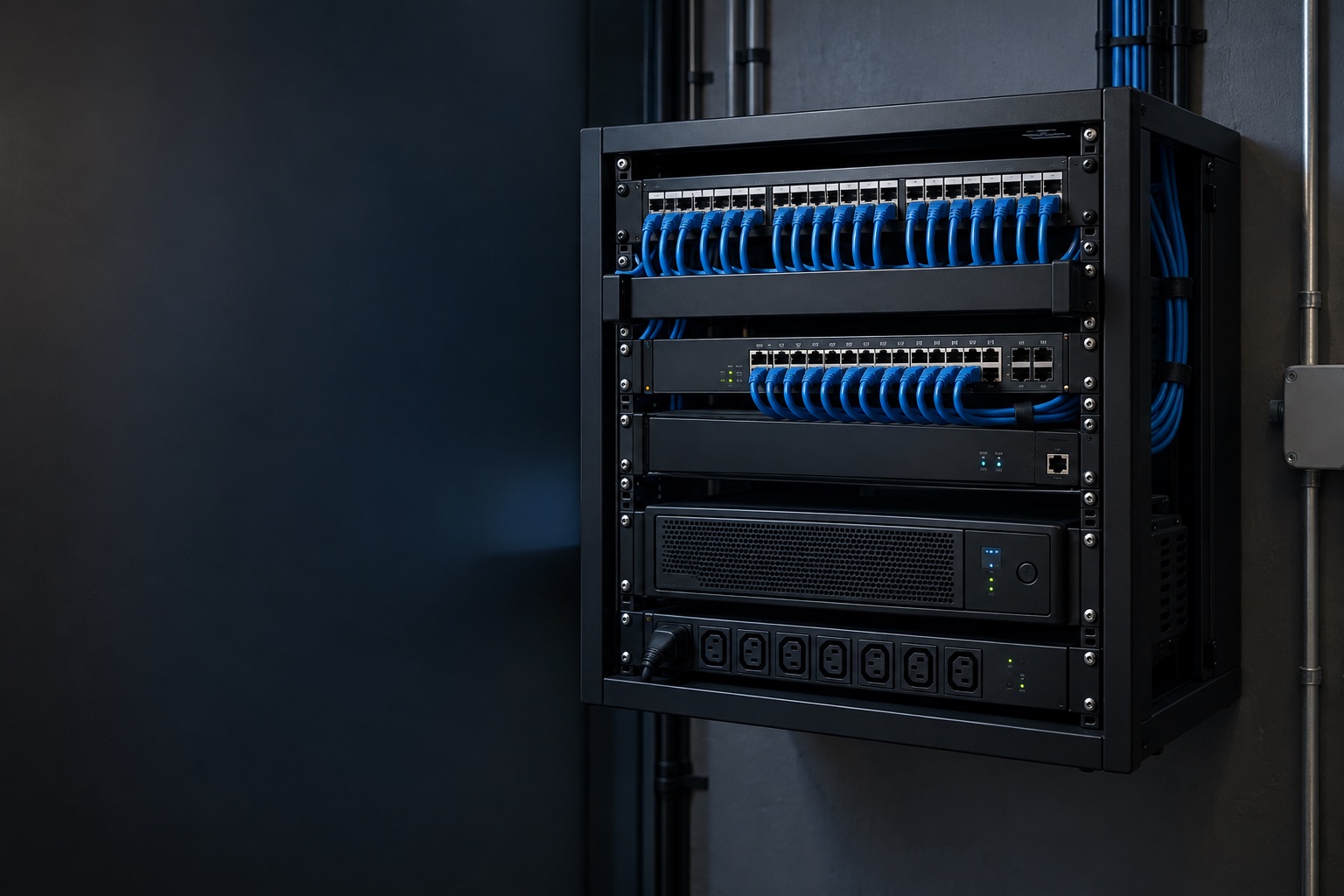
Racks & power
We give the network a proper physical home with labeled patching, cable management, airflow, managed power, and battery backup when the site requires it.
What goes wrong
Equipment stacked on shelves, tangled patching, weak ventilation, and one unprotected power strip make every service event slower and riskier.
It is exposed to heat, movement, spills, and accidental disconnection.
The network drops while gateways, switches, phones, and recorders restart.
One failed device means asking someone onsite to find the right plug.
What we install
Rack labor covers assembly and organization. Rack hardware, patching components, pathways, and power equipment remain separate materials unless listed.
Wall or floor rack assembly, equipment placement, cable management, patching, and labels.
Quoted from the connected load and target runtime. It can ride through short outages and support an orderly shutdown.
USP-PDU-Pro is required in Site Pro and Fleet Standard, allowing supported equipment outlets to be managed remotely.
Equipment and patching are organized so future work begins with a usable map.
How we scope it
We review where equipment lives, rack depth, wall support, ventilation, cable entry, electrical availability, connected load, and what must stay powered during an outage.
Managed power distribution is not battery backup. A UPS is a separate, site-sized item.
Common questions
No. Smaller systems may fit a compact wall enclosure when space, access, ventilation, and equipment depth allow it.
Runtime depends on load, battery capacity, and battery condition. Capacity and target runtime are quoted after the connected equipment is confirmed.
Yes. Remediation is quoted after the equipment, cabling, access, and outage window are reviewed.
Build the physical foundation
Add rack labor and quoted battery backup to the physical-work step.